
Looking for Religion Story Ideas? (December 2025)



From Quakers to Kwanzaa and beyond
Sponsored by the Communications Committee of the International Association of Religion Journalists (IARJ), these short columns are designed as brainstorming opportunities. And, we want to thank IARJ members who already have sent us suggestions for future columns!
What’s that newsy buzz from those quiet Quakers?
Religion writers who have reported on the Friends over the years know that most of our stories have included the context that Quakers, overall, are a declining group. That’s why we like to report on a surprisingly active congregation we may find—or a notable person who newly identifies as Quaker. But I have to admit surprise in reading Associated Press writer Luis Andres Henao’s report, headlined, “Young adults turn to Quakers’ silent worship to offset—and cope with—a noisy world.” Henao’s story is packed with solid background information as he reports on the surprising growth in one particular congregation: the Arch Street Meeting House in Philadelphia. In fact, this is surprising not only because Arch Street itself had been declining, but also because the movement globally still is caught up in what seems to be a relentless decline—apparently with one geographic exception that’s well worth exploring: Africa. In fact, the Quaker movement continues to grow in Kenya, at least according to some global reports. All of this leaves me very curious about the state of Quaker communities worldwide, especially wanting to know a lot more about what’s happening in Africa. If you’ve got a newsworthy Quaker story in your corner of the planet, be sure to let the IARJ know about it.
Who will be the final survivors of World War II?
In my July column, I included a story idea under the sub-head, “Hundreds of these storytellers are dying everyday” about the fading numbers of WWII veterans. Then, in my September column, I added a suggestion, “Consider interviewing a Holocaust survivor.” These two items sparked emails from our colleagues asking: “Who is keeping track of the final survivors?” Journalists based in the U.S. reminded us this autumn, when we passed the 80th anniversary of the end of the war, that only about 45,000 men and women are left from the more than 16 million Americans who served in WWII. In the U.S., tracking those survivors is relatively easy compared with the challenge journalists are facing around the world, trying to find survivors through databases and archives that vary widely across the continents where that global conflict was fought. I am convinced that there are many fascinating “religion stories” among those survivors’ accounts—and, sparked by your emails, I am sad to be reminded of how rapidly this fateful clock is ticking. Please do use my email (below) to let me know more about stories you’re reporting related to WWII survivors. I am fascinated by your questions, ideas and your work.
And speaking of elderly folks who need special care …
Talk about surprising! I must thank the Hallmark Channel in the U.S. for sparking this story idea. In a new made-for-TV movie on Hallmark, A Keller Family Christmas Vacation, the scriptwriters made a point of telling viewers about the groundbreaking work of the Hogeweyk village in the Netherlands that serves as a model for urban design adapted to the needs of people living with dementia. In the movie, one character actually proposes that planners try to create more model villages, based on Hogeweyk, to accommodate families living with other disorders such as Parkinson’s. Religion specialists in journalism, of course, know the deep roots of religious groups in sparking health-care innovations over many centuries. Religious denominations, nonprofits and even individual congregations around the world are experimenting with various forms of caregiving all the time. Having stumbled across such a startling “call to action” by the Hallmark network to its viewers in that lighthearted holiday movie, now I’m wondering what great stories we might find of groundbreaking partnerships between religious groups and model caregiving programs around the world, this season. If you find such a story, let us know at the IARJ.
Who is celebrating Kwanzaa this year?
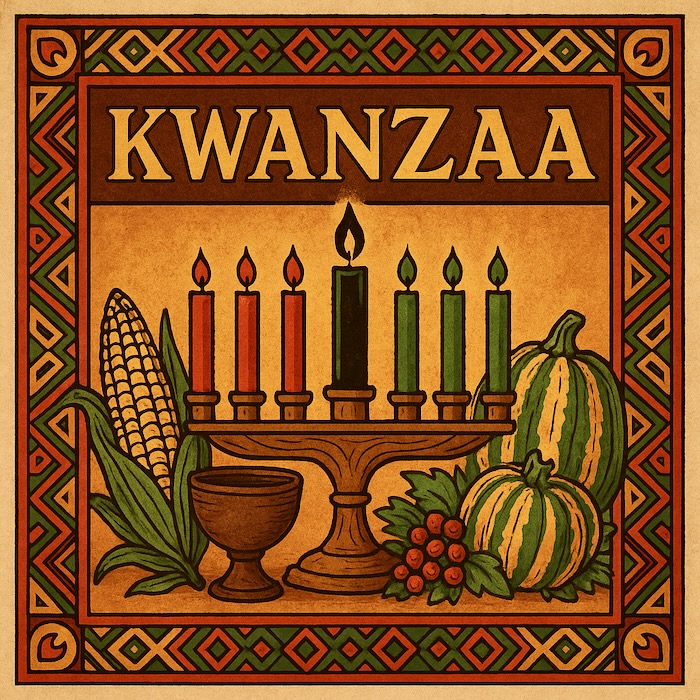
Dr. Maulana Karenga, who is 84 this December, is amazed to see the holiday-festival he established in 1966 continue to grow both in the U.S. and around the world. Veterans of the religion beat know that thousands of people have tried to establish holidays over the past century only to find their efforts fizzling. Dr. Karenga’s efforts are an extremely rare exception! His six-day festival, which he designed as a way for families with African roots to reclaim positive cultural values, now is marked in some way by as many as 2 million people around the world. For years, this was regarded as a primarily American story—since that was the first focus of Karenga’s campaign. However, if you have watched the growth of Kwanzaa carefully, you may have seen the festival growing in popularity in Canada, Brazil, Jamaica—and even in some areas of South Africa. We’re hearing it might even be marked by some families in France. A search of global news coverage of Kwanzaa, however, turns up only spotty efforts among religion reporters to chart the festival’s growth. Stories pop up here and there, sometimes in small-town newspapers or brief TV reports. We are coming up on the 60th anniversary of Dr. Karenga’s festival in 2026, so this is a good year to inquire about Kwanzaa among groups in your part of the world with African roots.
And who is planning a St. Francis pilgrimage?
Looking ahead into the 2026 calendar, you will find that travel companies that specialize in booking tours for religious groups already are promoting St. Francis pilgrimages that will be whizzing around our planet in early 2026. Wherever you live in the world, there’s probably a travel agent booking such trips right now. A lot of this excitement arose with news from the Vatican in October that St. Francis’s body will be moved to a public site for the 800th anniversary of his death. The Vatican reported, in part: “The announcement of the public display for veneration comes from the Sacro Convento in Assisi on the day the Church and the world celebrate the feast of the Saint Francis of Assisi. Thanks to the approval of Pope Leo XIV, the body of the Saint, on the occasion of the 800th anniversary of his death, will be moved from his tomb, located in the crypt of the Franciscan basilica, and placed at the foot of the papal altar in the lower church.” That represents “the first extended public display of the mortal remains of Saint Francis for an entire month—22 February to 22 March 2026.” There are countless stories already cropping up in every corner of the planet as pilgrims plan ahead for this once-in-a-lifetime journey.
Share ideas with us
Let’s make this as easy as possible: David Crumm, a veteran religion writer, magazine editor and publisher based in Michigan in the U.S., writes this column on behalf of the IARJ Communications Committee. If you’ve got further ideas to share about any item in this column, email David directly at [email protected]
Or, if you’ve reported these kinds of stories, send David a link that we can include in a future column.
The IARJ is dedicated to assisting religion journalists around the world to help each other find ever more meaningful ways to report on the significant impact of religion in communities around the world.