Looking for Religion Story Ideas? (February 2026)



EDITOR’s NOTE: Sponsored by the Communications Committee of the International Association of Religion Journalists (IARJ), these columns are designed as brainstorming opportunities. For the February 2026 edition, Stephanie Fenton was invited to write our monthly “story ideas” column.
When is Ramadan?
Sounds like such a simple question, doesn’t it? But, on the morning we are posting this column, Wikipedia, Google and a couple of popular search engines disagreed on the starting date of this special month that is so vital to 2 billion Muslims around the world. How could there be a conflict over such a basic date?
Welcome to the specialty within religion journalism that I have followed for a couple of decades now: Researching and reporting on religious and cultural holidays, festivals, milestones, anniversaries and observances around the world. Conflicts over dates, even for observances as major as Ramadan, are common. In the case of Ramadan, there are three main reasons that we don’t have a single, unified date:
First: New AI-powered searches are notoriously flawed in calculating dates of events, because these engines are built to draw on information from past publications. Thus, they’re frequently confusing future dates with all the past dates already posted online. So far, it’s a “baked in” fatal flaw in current versions of AI when it comes to “moveable” dates. With an observance as complex as the first “day” of Ramadan, AI can’t hope to keep up with actual reporting.
Second: Part of this challenge is an essential element in Muslim tradition. Ramadan begins with the sighting of the first crescent of a new moon. Many communities around the world now follow well-established authorities’ “official dates” that are announced in countries such as Saudi Arabia. But, some Muslim communities still follow local or regional sightings that easily can vary by a day or two. In other words, there may not be a single date on which Ramadan begins for everyone worldwide.
Third: While sophisticated scientific calculations of moon cycles do exist, the fact is that the possibility of actually sighting a crescent varies around the surface of the Earth and is complicated by factors such as weather. If a particular Muslim community decides to rely on a physical sighting of the moon, that might not occur on the same schedule with other sighting that are possible in other regions.
In other words, if you simply type the 3-word question into a search engine—“When is Ramadan?”—you’ve got a less than 50-percent shot at getting a correct answer. And that’s not good enough for serious journalism. I was especially alarmed by these deep AI-related flaws in early January 2026 when I researched the new annual Interfaith Holidays & Festivals calendar for the weekly magazine where my columns appear: ReadTheSpirit.com. I spent weeks of painstaking research to calculate our 2026 calendar that we know is widely used as a guide by educators, healthcare workers, community leaders, media professionals, parents and religious leaders. (And by the way: One reason that calendar is so popular is that we publish it under Creative Commons so people are free to share it.)
Having said all of that about the care we take in fact checking, nevertheless, we also publish the new calendar each year with a sincere invitation to readers to contact us with possible additions and corrections. I know full well that, despite my research, I might have made a mistake somewhere.
That’s the highly specialized work I’ve developed over my career as a religion journalist—and that’s just the first step in such reporting!
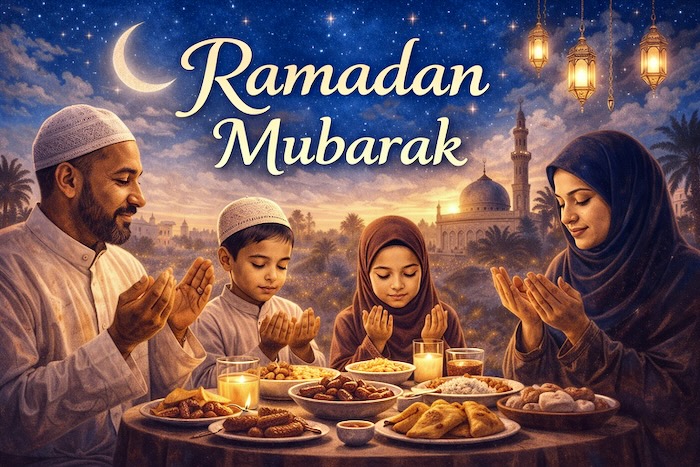
Then, there’s so much more to consider. For example, as in the illustration at the top of this column, in your reporting on Ramadan are you reflecting for your audience the fact that this annual religious festival is far more than the experience of daytime fasting? It’s also a deep encounter with the Quran itself—the core of Ramadan spirituality. And, as much as it’s about fasting—Ramadan is also about food! Muslim families know that the nights of Ramadan are filled with wonderful gatherings as family and friends share favorite foods. In other words: It’s entirely appropriate to write a Ramadan story about the most popular Ramadan recipes in your part of the world. In fact, I know that readers love stories about food with accompanying recipes.
Challenges for journalists reporting on religious Holidays, Festivals & Milestones come in many forms, including variations in the “name” used to identify the observance. For example, the major Jewish holiday of Passover is also known as Pesach (Hebrew for “passed over”); Chag HaMatzot (Feast of Unleavened Bread); Chag HaPesach (Festival of the Paschal Sacrifice); Chag HaAviv (Festival of Spring); and Z’man Cheiruteinu (Season of Our Freedom).
Then, there are regional and cultural variants of celebrations. Some holidays and festivals arose in the heart of complex regional cultures and, today, are expressed in widely different ways by the various religious or cultural groups with roots in that region. Reporting on festivals focused on the elephant-shaped Ganesh, for example, shows that the scope and the nature of such celebrations varies across India and in the Indian diaspora around the world.
If you haven’t reported on “Obon,” check it out this year in your reporting. You’ll quickly discover that there are three primary variants of the globally recognized Japanese Obon festival: Shichigatsu Bon (Bon in July, based on the solar calendar and celebrated in eastern Japan); Hachigatsu Bon (Bon in August, based on the lunar calendar and celebrated most commonly); and Kyu Bon (Old Bon, celebrated on the 15th day of the seventh month of the lunar calendar). Try answering the question: When is Obon? Good luck.
Variations in dates are far more common than you may realize. For example, in 2026, the United States Conference of Catholic Bishops moved the Solemnity of the Ascension of the Lord from Thursday, May 14, to Sunday, May 17, in all ecclesiastical provinces of the U.S.—with the exception of the provinces of Boston, Hartford, New York, Omaha and Philadelphia. That’s a challenge for religion journalists who might want to report on that observance for an audience that crosses all those boundaries.
Here’s another common challenge: Have you ever “missed” a holiday because it was “moved” by the adherents themselves without telling “outsiders”? Yes, this happens! Sometimes, a journalist can draft a story about a holiday—only to discover that the followers of that religious minority already have marked the day on an alternate, earlier date! Why? In some parts of the world where members of a religious group are relatively few in numbers, those followers might decide to move their whole observance off of the “official” date to gather people, instead, on a more convenient “weekend.”
In our world today, it’s up to journalists to report the truth about religion so that readers can understand more than just a summary created by artificial intelligence—summaries that I know from my own work are deeply flawed.
If people are to understand the faith of their neighbors, let’s show them how people are celebrating or observing experiences and values that shape their lives in so many ways. Let’s help readers to know that religion is, in so many ways, a unique living legacy that has the potential to connect all of us into the far larger story of humanity that we share.
Names vary, traditions vary, and observances often reflect the people and places where they occur—and it is our vocation journalists to capture that with all the accuracy, fairness and balance that we are called to muster.
So, what is the answer to the question: When is Ramadan?
As of the February 1 posting of this column, global sources are reporting that the first “daytime” portion of the month-long fast will be Wednesday 18 or Thursday 19. As we get closer to those dates, the fasting may wind up starting on different days in various communities around the world. Throughout the first couple of weeks of February, we all will have to keep checking the best sources in our parts of the globe. Ramadan likely will wind up starting on more than one date.