Religion Story Ideas, July 2026 edition



What does AI say about religion in your part of the world?
Exploring AI’s strength and weakness in reporting on faith
EDITOR’s NOTE: Sponsored by the Communications Committee of the International Association of Religion Journalists (IARJ), these columns are designed as brainstorming opportunities. To send us suggestions or responses, see the contact information below.
Like or not, our daily work as religion journalists in 2026 feels much like Dorothy, the Scarecrow, the Tin Woodman and the Lion approaching the Wizard of Oz’s palace—filled with high hopes and deep fears about what this “Great and Powerful Oz” is thinking.
Our Oz, of course, is AI.
Whether you have learned to use AI tools and like them, or you are horrified by AI and are campaigning against its use, the fact is that AI has rapidly formed a vast new “mind of the Internet” that did not previously exist in our world. With that phrase, I’m including what AI researchers describe as “the problem of AI’s Black Box,” which refers to the opacity of advanced artificial intelligence systems, particularly deep learning and neural-like networks. Now that AI is embedded in everything from our smartphones to our choices of what to watch on our home TV screens, the Oz-like fear is that the internal logic and decision-making process already has become too complex for humans to clearly trace or understand it.
All we can do is try to double- and triple-check AI responses and use anything we find very, very carefully in our own ongoing work.
The mysterious reach of AI
First, a bit of background: I am writing this column as the founding Editor of a mid-sized publishing house, based in the U.S., that specializes in publishing books about cultural and religious diversity as well as other community issues, including healthcare. We limit our use of AI as a basic research tool to supplementing our own expert research and reporting. We do not publish AI-written works or AI-designed book covers. However, we have used AI-generated illustrations in issues of our online magazine.
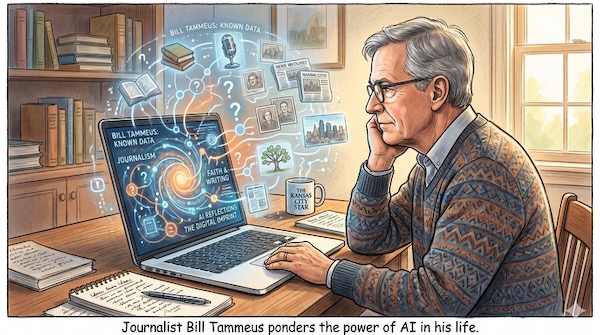
With good-natured humor, that’s how we used AI to create the illustration (above) that’s supposed to show the award-winning American religion journalist Bill Tammeus contemplating the advance of AI into his world through his laptop.
When this illustration was published, we immediately heard from Bill (and his wife), explaining why that illustration is inaccurate. He emailed: “Just for the record, neither my wife nor I think that’s a particularly good AI image of me. For one thing, it has what I take to be a steaming cup of coffee on my desk. I don’t drink coffee. But AI’s failed effort is not a surprise to us.”
OK, so we might place that little experiment in the “fun stuff” category and, yes, we fully disclosed what we were doing there to the public. It’s a light-hearted example.
However, AI research into religion isn’t trivial. AI’s relationship to religious tradition, belief and culture is complex, valuable and also potentially dangerous in propagating errors or fueling bias.
Let’s experiment with AI together
That’s why this “IARJ Story Idea Column, July 2026 Edition” is urging colleagues around the world to experiment with AI where you live and then contact us with what you’re finding. Send us links to columns you are writing or full-scale news stories you’re producing.
One colleague currently doing that is the veteran American journalist Bill Mitchell, who you may recall was a long-time Europe Correspondent for Knight Ridder newspapers and later was Publisher and CEO of The National Catholic Reporter. Bill now is in the vanguard of writing columns about emerging issues in journalism, including his experiments with AI and religion.
His most recent is headlined, AI Goes to Confession, in which he describes how he used AI to help explore deeper meanings and associations with Pope Leo XIV’s encyclical on AI. Here’s his key finding: In the course of using Gemini to help me explore Magnifica Humanitas, I encountered three dangerous weaknesses of AI: sycophancy, hallucinations and a combination of the two that ChatGPT describes as “self-correction failure.”
Obviously, the relationship of AI with religion needs further exploration.
So, what should we ask AI?
Bill’s experiment with the encyclical involved lots of questions to see the range of AI’s expertise as well as potential errors.
Here are a few fascinating questions to ask AI where you live:
How does (insert the name of a religious group in your area) mark the seasons of the year? You’ll almost certainly be surprised by seasonal references within religious traditions.
What does (name of a religious group) tell members about their diet or foods they should or should not eat?
What traditional symbols of (name of a religious group) show up prominently in communities in this region?
What are the most popular pieces of music among members of (religious group)?
That’s probably enough prompting. Please, develop your own questions, but please do experiment. You’ll most likely find some fascinating details that could spark an upcoming story. And, if you read carefully, you will find some errors, too. It’s worth reporting on the origins of such incorrect information and downright prejudice picked up by AI. Is there a way to correct or resolve such biases?
Please let us know what you find, send us links to your stories, and together we will learn more about this emerging “mind of the Internet.”
Share with us
Let’s make this as easy as possible: David Crumm, a veteran religion writer, magazine editor and publisher based in Michigan in the U.S., writes this column on behalf of the IARJ Communications Committee. If you’ve got further ideas to share about any item in this column, email David directly at david.crumm @ gmail.com
Or, if you’ve reported these kinds of stories, send David a link that we can include in a future column.
The IARJ is dedicated to assisting religion journalists around the world to help each other find ever more meaningful ways to report on the significant impact of religion in communities around the world.