
Religion Story Ideas, June 2026 edition



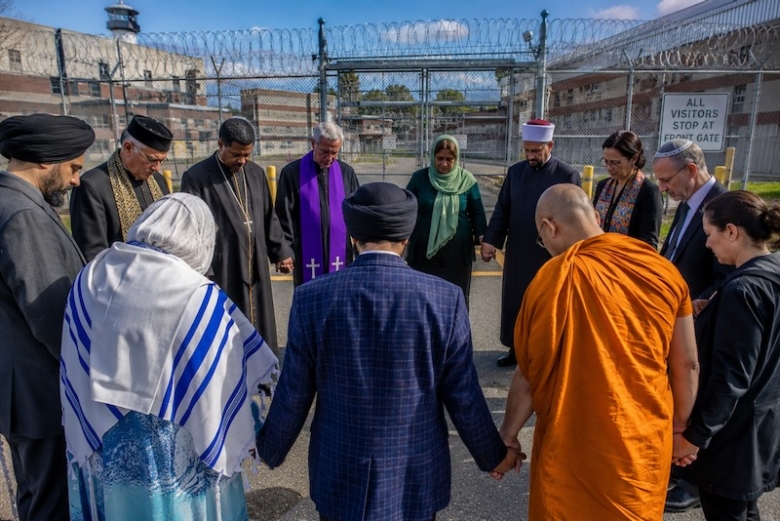
Where will the world’s most important interfaith gatherings arise in 2026?
EDITOR’s NOTE: Sponsored by the Communications Committee of the International Association of Religion Journalists (IARJ), these columns are designed as brainstorming opportunities.
About a month ago—in the weekly online magazine that I’ve edited for the past two decades, ReadTheSpirit.com—I published the photo above of an interfaith group of clergy praying outside a maximum-security prison to peacefully protest the ongoing use of the death penalty in more than two dozen American states. That image touched off a spirited conversation among our magazine readers both in the U.S. and around the world.
Two fascinating questions emerged: Where are the most important interfaith gatherings in our world today? Could it be that the next wave of interreligious gatherings will be peaceful protests on behalf of the world’s most vulnerable?
And, so, in this June 2026 edition of our monthly IARJ “Story Ideas” column, I am recommending these questions to you as journalists who specialize in covering religion around the world.
To further spark your interest, here’s another version of the question: In your region of the world, where are the places that people from multiple religions come together to meet, perhaps pray, and even plan projects together? If you report such stories, please email me (see the contact info below), because I would like to amplify your coverage for readers in other parts of the world.
A Snapshot of the Background for this Story
This column is written in English using a term that became common in the U.S. after World War II, synonymous with the equally popular word “interreligious.” The word “ecumenical,” which has been used in American media for more than two centuries refers to experiences in which people from various Christian denominations participate in events. Then, after the Holocaust, the rise of efforts to bring Christians and Jews together across the U.S. led to the growth of “interfaith” and “interreligious” events.
In your part of the world, you will need to explore what terms are used—and how such crossings of religious lines are understood and described by the people you cover.
The Vatican, the host of the world’s most newsworthy interfaith events since the 1960s, prefers to use the term “interreligious.” Vatican staffers argue that term is more accurate in clarifying that these are people coming together from various distinct “religions” and that the Vatican is not promoting the formation of some kind of new “faith.” The name of the Vatican department responsible for these issues in Italian is the Dicastero per il Dialogo Interrelgioso.
The world’s many different cultural approaches to this concept are vital windows into our national identities. During the Cold War, for example, Eastern European countries had departments that, in English translation, were assigned to “control cults,” meaning religious groups. In India, interfaith relationships have been unfolding for thousands of years—sometimes through violent clashes and sometimes through remarkable hospitality. The Indian experience is colored by many different terms, places and experiences. Or, if you choose to focus on a particular global religion that includes an annual focus on such gatherings, look into the history of Baha’I World Religion Day (although that’s in January each year).
If you are reading this as a veteran of the “religion beat,” then you know this history by heart. But here’s a quick overview: In 1893 the Parliament of the World’s Religions held the first World’s Congress of Religion in the World’s Columbian Exposition in Chicago. That was organized and dominated by Christian leaders, but it is credited as the ground-breaking East-meets-West appearance of Swami Vivekananda. In 1900, the first International Congress for the History of Religions was held in Paris. In 1964, the Holy See founded its Dicastery for Interreligious Dialogue with its Pontifical universities in Rome.
What you may not know is that historians of religion, in an upcoming but still unpublished history of the interfaith movement, credit the Temple of Understanding’s “First Spiritual Summit” in October 1968 in Calcutta, India, as: The first truly global interfaith gathering hosted by leaders from many faiths in a location outside of the majority-Christian world. It was at that gathering, just weeks before his tragic death in Thailand, that Thomas Merton delivered his landmark appeal to the world for religious leaders to come together in pursuit of peace.
Signs Pope Leo XIV is refocusing interreligious efforts
Pope Leo XIV has signaled that he also wants to use interfaith events to demonstrate the potential of peace in our deeply divided world. For example, there was significant global news coverage of Leo’s appeal for unity and coexistence in an interreligious event in Beirut in late 2025. Then, this year, Leo reversed his predecessor Francis’s plans to expand the planning for huge Catholic gatherings, such as the now-cancelled 2026 Children’s Day at the Vatican, to focus instead on pastoral efforts more specifically adapted to the many diverse regions of our world.
As of the publication of this column (and that could change any day, of course), there is no global interreligious gathering on the Vatican’s public schedule.
Something important and historic is happening here in interreligious relationships. Following Leo’s writings about the need for religious leaders in every region of the world to focus on ministries to welcome and protect the world’s most vulnerable—we could be seeing our next important wave of interfaith gatherings looking much more like the photo-illustration at the top of this column.
So, what’s happening in your corner of the world? That’s the whole point of this “Story Ideas” column. I’ve tried to sketch the essential background and provide a bit of analysis that you could use to explore interfaith gatherings in your corner of the world.
Report on this from your regional perspective, please. If you do publish an article, send me a link. I’d be pleased to amplify your work across our online platforms.
Share with us
Let’s make this as easy as possible: David Crumm, a veteran religion writer, magazine editor and publisher based in Michigan in the U.S., writes this column on behalf of the IARJ Communications Committee. If you’ve got further ideas to share about any item in this column, email David directly at [email protected]
Or, if you’ve reported these kinds of stories, send David a link that we can include in a future column.
The IARJ is dedicated to assisting religion journalists around the world to help each other find ever more meaningful ways to report on the significant impact of religion in communities around the world.